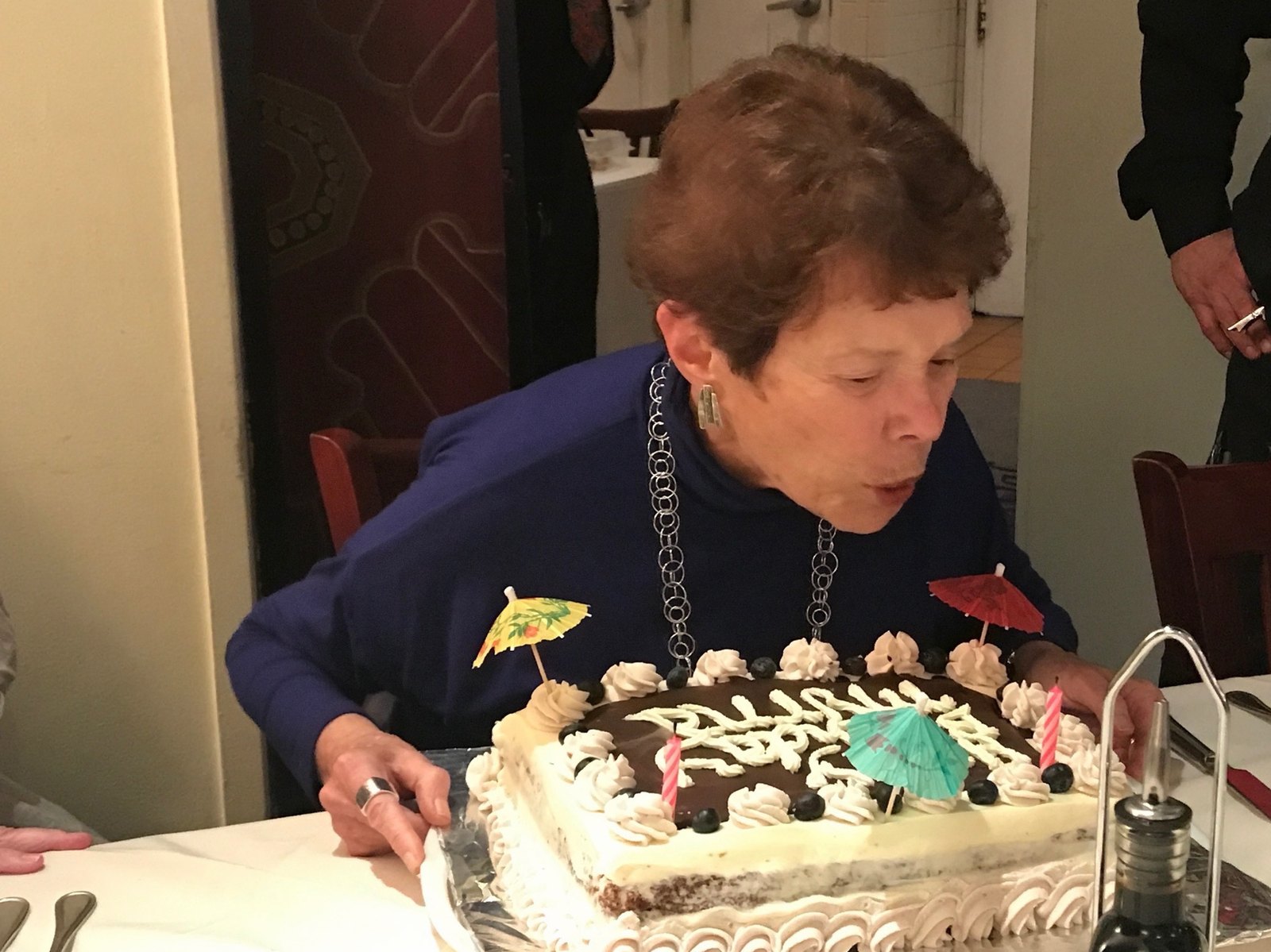
And so we arrive at the day we have been dreading. It is easy to be very sad about Mom’s death. It is also easy to celebrate and commemorate her incredibly productive, humanity facing, and unusual life.
During the one year since doctors diagnosed her illness, I’ve been thinking about many beautiful traits she shared with her mother Pauline of blessed memory. In Myrna’s obituary for her own mother, Pauline was a woman who never had “idle hands”. Mom was that way too, never with idle hands. Even in the year of her illness, Mom actively participated in a book club which met regularly, a writer’s club, this synagogue’s Rabbinical search committee, her apartment building’s tenant committee, and tutoring English to a DC area Afghani child. This doesn’t count her many informal activities.
Today, I’ll utilize a literary device Mom might have tried in her writing club. What follows are a series of chapters and anecdotes.
Chapter 1: How Mom Died is How She Lived
Mom was in Oaxaca Mexico last February when she started feeling abdominal pain. For the past five years or so, interrupted only by covid, she regularly went to Oaxaca for about a month. She traveled with her friend of almost 80 years, Sydelle. [It's been a tough week for Sydelle. She lost two close Brooklyn childhood friends this week, including Mom.]
Mom returned to Washington and saw doctors. They ran tests. They determined she had pancreatic cancer. Surgery was not an option. Mom was always adamant about focusing on quality of life. After numerous meetings with her doctors, Jonathan and me, Mom opted for a second level and less aggressive level of chemotherapy. This was to stabilize her tumor and minimize pain.
Mom was magnificent in the course of dying, as she was in life. She was stoic, philosophic, accepting and full of grace. Of course she wanted more time. She also made peace with her long life and was grateful for many adventures she enjoyed.
Mom spent spring and summer 2023 up and down the east coast, visiting children and grandchildren. While still reasonably mobile, she organized and curated a grandchildren’s cousins’ DC weekend. More on that soon.
In October 2023, we organized a family zoom for all the grandchildren and Mom on her 87th birthday. Considering she traveled to nearly 90 countries and lived intrepidly, one grandchild asked: what was her best ever birthday and why? Without missing a beat, she said “this one, this one is the best, we are all together sharing stories and catching up.”
For Thanksgiving. Mom’s six grandchildren, Jonathan, Mary and I had a wonderful and memorable meal at LeFerme in Chevy Chase. Ten of us sat for the Thanksgiving meal. Nine of us were able to eat. Her grandchildren say our last Thanksgiving with Mom will be a lifetime memory.
About two weeks ago, Rabbi Rachel came to visit Mom in the hospital. Rachel asked how Mom was doing. I answered Mom had lost her mobility, agency, facility, and sometimes dignity, but not her sense of humor. We all laughed together, perhaps the best form of medicine.
Not long after, Jonathan took Mom to a doctor’s appointment. Mom had recently received a pain block to help increase clear minded-ness. In that appointment, Mom bravely said she was ready for hospice.
During her last hours, a beautiful sunset began outside her bedroom window. Shadows in the clouds deepened. Sunset colors moved from yellows to oranges. Darkness of night arrived. We believe Mom was relaxed. We were bedside for her final breaths. Consistent with prior discussions, we opened her bedroom window. Like the door we open every Passover for Elijah, now her open window enabled her move in the opposite direction.
In the end, Mom met death the best way possible. She died on her own terms. At home. In near full control of her decisions. Surrounded by quiet, love and the life affirming beauty of an apartment decorated with artwork of exotic and interesting places. She lived life extremely well. Her children kept vigil, and kept her comfortable. We accompanied her on the final goodbye as far as we could.
Her life was superb and her death was calm and full of love.
Chapter Two. Her Parents and Our Legacy
My dear children, nieces and nephew. Mom’s legacy to and for you began in 1921. Her mother Pauline came to America then. Pauline traveled with her mother and older sister. A few months later, just after Passover 1922, Myrna’s father Carl (his German name, and Chaim his Yiddish name) traveled through Ellis Island with a cousin.
Chaim, later anglicized to Hyman or Hy, was 16 years old. Mom’s parents grew up in Austria- Hungary. Post the Great War, their hometowns became the Bukavina area of Rumania. Their towns were similar in descriptive terms to the fabled shetl of Anatevka in Fiddler on the Roof. Hy was a horse trader. He was paid solely on commission and there weren’t many (or any) transactions. Hy’s horse trading days were limited. Also, there were pograms. And there was risk of army conscription.
Mom’s parents’ homes in Rumania were very modest. They had dirt floors. At one point, after fleeing an approaching army, Hy returned home with his parents to discover the army used the house for barracks and had installed wooden floors. This is perhaps a rare example of an army leaving a place better than originally.
Hy traveled at 16 to America. He married Pauline. Over time, the young couple rented an apartment on St. Marks Avenue in Brooklyn. Her older brother Sam was born in 1934. Mom followed two years later in 1936. Uncle Dan was born in 1943.
The St. Marks apartment where Mom and Sam lived in the early years was a railway flat. To reach a back room, one had to travel through front rooms. There were no hallways. Mom and older brother Sam shared a room. While born 30 months apart, Sam and Mom were protective of each other like twins. I think this was due partly to sharing a room and living in such close quarters.
During the Second World War, Mom and Sam recycled cans and newspapers for the war effort. She and Sam traced the progress of the war on a map they spread out on their bedroom floor.
Thus Mom’s life began very modestly, from dirt floors of her parents’ homes in the old country prior to the Great War to the floor of her railway flat during World War II.
Chapter 3: Early Marriage and Travel
After Mom married Julie, our father, in 1957. Mom was just shy of 21. She and Julie focused on their graduate studies and travelled extensively. In 1961, when Israel was only 13 years old, Mom and Julie considered making Aliyah. They lived in Israel for 18 months. Mom attended Ulpan, she worked intensively to learn Hebrew, and also worked in (social services) at a kibbutz.
Before returning to the States, Mom and Julie traveled extensively through countries of Western Europe.
About ten years later, in the early 1970s, we traveled as a family. We took an annual summer trip to Europe or Israel every summer for four years. How lucky we were. Our trips included Israel and countries in both western Europe and Eastern Europe. Other than Israel, we went places our parents did not visit in the 1960s. This included cities which for the last two plus decades have become fashionable to visit. Mom as usual was ahead of her time.
In a profound way, our early travel shaped my worldview and outlook. By osmosis, seeing how others lived, our family trips showed that for Mom, the world was an egalitarian place. All people are deserving of dignity. And health services, education, housing, and other basics of life. This is a major theme of her life.
Later on, when grandkids were older, Mom and grandchildren traveled. One granddaughter to Israel, two other granddaughters to LA for film camp, a fourth granddaughter to Oaxaca (at least once), a grandson to robotics camp, and most recently another grandson on an Alaskan cruise. These trips did not include birthday travel with Mom, including to Costa Rica and separately for some to Guatemala.
Mom’s often said her mother Pauline had greater dreams at night than she could live during the day. By travel and other activities, Mom relieved and addressed this mis-match. Mom lived all her dreams in daytime. There were no missed opportunities. What a magnificent blessing. Most parents wish for children to surpass experiences of earlier generations. Pauline would be proud.
Chapter 4: Shepherd Park
When I was born, Mom, Jonathan and Dad were living in an apartment on Missouri Avenue. A neighbor was a family which became friendly with ours for nearly 50 years. About 15 years later, I played high school football with one of the sons. The other son serendipitously became the first employer of Mom’s nephew by marriage. The father of the family was Jonathan’s orthodontist.
A theme here is the smallish quality of Washington Jewry. DC Jewish families we met when Mom was a young parent would be around literally the rest of Mom’s life.
In 1970, Mom and our father were ready to upgrade to a house. They selected the Shepherd Park neighborhood east of Rock Creek Park. We moved to Locust Road in 1970. Of importance, Shepherd Park was integrated. Our parents did not purchase from a traditional real estate agency. Instead they did the opposite. They went to a neighborhood and civil rights organization called “Neighbors Incorporated”. This entity was a non-profit to facilitate the transfer of real estate to avoid red-lining.
When we moved into our house on Locust Road in 1970, our immediate neighbors included a Polish family, an African American family, and a widow and cat lover who also was a government lawyer, rare for a working woman in the 1940s to 1960s. One house diagonal to us was first owned by a Jewish family intensively involved in the Solomon Schecter school (now JDS) where we attended, and then an orthodox Jewish family. A Hispanic family lived three doors down. And a Greek family, the Kletsidises, lived across the alley. An older Kletsidis sister was a part time babysitter for Jonathan and me. The younger son became my first best friend.
On Locust Road, to the question of where did you go and what did you do, our answers as kids were “We went out. We did nothing”. Of course, we did everything. Among many activities, Jonathan and I played touch football on the street. Jonathan’s best friend was our next door neighbor Michael Zajac. Michael was also the best football quarterback in the neighborhood.
I describe to friends that Locust Road was (air quotes) “the most integrated street in America”. Of course, there is no way or need to prove this. This is anecdotal and illustrative that to Mom, Locust Road was living by example. She did not talk the talk. Mom “walked the walk”. Neighbors Incorporated had done its job. With one exception, our immediate neighbors were not like us.
This was our happy home and neighborhood until 1976.
Chapter 5: Divorce and a Type of Liberation
Mom’s life, and ours, took a somber and more challenging turn in 1976. Mom was 40. At that time, our parents anticipated Jonathan beginning high school in Fall 1978. Like many parents of nearly high school age children, our parents began anticipating high school plans.
Around that time, we moved from Shepherd Park to Chevy Chase. This was to preserve for Jonathan an option to attend public high school. When we moved, we learned our father would not accompany us. So that year, 1976, became a hard transition.
Mom became a single parent. We became a single parent woman led household. Mom was already working so this transition did not involve her going back to work. Jonathan, always a highly intelligent, reliable, dependable child in a way had to become a father figure in the household. I think this was hard on Jonathan. It was not great for me either.
And Mom experienced stress and mental anguish. I could not articulate this at the time, but the air was palpable with discomfort, challenge and difficulty. Also, around this time, Mom’s parents moved to a retirement development in Fort Lauderdale. Mom, Jonathan and I made what I recall was our first ever trip alone, without her husband and our father, to see Mom’s parents.
It was a sad time. Mom responded as she always did. With grit and fortitude. There became a new system in the household. We would have a chore list. I vaguely recall the first system was a chore wheel. This did not work well. The wheel could be subject to manipulation, possibly by me. If dinner comprised food which made pots hard to scrub, and it was my day for pots rather than clearing dishes, “magically” the wheel could turn favorably. Fairly quickly, Mom changed to a written system of immovable squares. Jonathan had to scrub pots Mondays and Wednesdays. I had to scrub the pots Tuesdays and Thursdays. On Friday night Shabbat dinners, we rotated.
Mom was resilient. As a divorced woman, she leaned in decades before the term became a national female workers’ mantra. Mom’s self empowerment was a demonstration that necessity is the mother of invention. I suppose we can say in our house, “necessity was the Myrna of self-invention.”
And slowly joy returned.
Chapter 6: Africa
In the fall of 1982, Jonathan left for college. This provided Mom an opportunity and a challenge as well. Opportunity came from an odd source, Ronald Reagan. Mom earned her second masters degree, this time in reproductive health in the mid 1970s. By the early 1980s, the Reagan administration apparently was more favorable on funding reproductive health overseas and less so at home. There was a need in Africa. Logistically this posed a problem as Mogadishu is 7,830 miles from Washington.
For Mom, a solution was needed. Around this time, a work colleague of Mom’s and a friend, was self-imploding in Cleveland Ohio. Mom’s friend was a technical grant writer with Mom years before at her place of work. The friend was daughter of a small town Ohio pastor, and alcoholism ran in the family. Mom’s friend hit rock bottom. She was subsisting in windswept and filthy doorways of buildings in downtown Cleveland,. A church group intervened and Mom’s friend chose sobriety and survival. The friend was in a halfway house when the founder of Mom’s workplace called. He was thinking about facilitating her move back to DC to re-employ her.
However, the friend needed a temporary place to stay to exit the halfway house. Mom saw an opportunity. Her friend would come to live with us temporarily. She would be an adult in the house starting my sophomore year of high school. She would keep an eye on me (good luck with that), and Mom would begin a multi-year phase of traveling to Africa several times per year to begin her fieldwork.
The temporary arrangement lasted 13 years. Her friend helped catalyze an important and enduring promise for Mom. Always independent minded, Africa was a major step on Mom’s path to even greater independence and liberation.
Mom’s fascinating and life affirming Africa stories and adventures are numerous. Here is one anecdote. After about a year, Mom began bringing home the most evocative photos taken concurrent with her Somalia program. Mom enlarged these. One in particular resonates 40 years later. A line of Somali women are standing near a traditional housing structure. The structure was large and round, with straw walls and a pitched thatched roof. There are six to eight women standing astride, upright, solemn, and proud. They are beautiful with high cheek bones and a regal bearing.
When Mom hung this picture at home, the value and importance of her mission became ever clearer. She was a citizen of the world, and helping out in the world. She was there to engage in Mitzvah for an alcohol reforming preacher’s daughter lost in a Cleveland doorway, and to help bring reproductive health habits to Somali women halfway across the world.
Chapter 7: Passover
Passover in our Mom’s house was the everything holiday. It was Thanksgiving, Chanukah, and Rosh HaShanah, all rolled into one.
Mom’s preparation began days before. When Mom’s mother was alive, preparation included home made gefilte fish. This took at least two days, including preparing pike and whitefish from scratch. In the days of her grandparents on the lower east side, fish were actually kept alive in a bathtub. Mom did not keep live fish in the bathtub, thankfully.
Mom wrote a supplemental Haggadah of readings for the Seder in 1984. She entitled it “The Haggadah is the Telling”. This included more than 25 separate readings. Mom would call on participants around the table to read sections from the supplemental reader. Two of my favorites are “Pharoah the Archtyrant” and “Passover has come to the Ghetto Again”.
In the first, the Pharoah of the Passover story is not the only one in Jewish history. Instead he is every tyrant who enslaves subjects – Jewish and others -- throughout history.
In Passover in the Ghetto, the beginning is gripping: “Passover has come to the ghetto again, The wine has no grape, the Matzah no grain, But the people anew sing the wonders of old”.
Passover was beloved and universal to Mom. Passover was like Abram’s tent in the desert before Sara became pregnant at age 99 per the Torah. Our home was essentially open on four sides. One year, Mom worked closely with an African program colleague who was a theologian. He attended our Seder in a full dashiki. He regaled us with stories, and I’d like to think we did likewise. Ours is a bit of an ecumenical family. As you’ll hear next from Jonathan, Mom hedged her theological bets.
Mom’s Final Chapter: The Long Good Night
While Mom is no longer with us in temporal and physical form, she resides in us in perpetuity. Jonathan and I are blessed, along with cousin Rhona, to have been old enough to know Mom’s parents so well. Our children are similarly blessed. They reached ages, and sufficient perspective, to know Mom well.
Mom was always working on travel and get togethers for grandchildren. In her last year, Mom codified this into a so-called “Cousins’ Weekend”. She arranged fun activities for grandkids, including Segway tours of DC, museum tours, theater-going, and even attending a Renaissance Festival at Glen Echo. Of course, Glen Echo included a visit to the old fashioned carousel.
Cousins’ Weekend was so important to Mom that she formalized her plan to ensure continuity after she died.
To her six grandchildren, Mom bridges the dirt floor structures of her parents in Rumania to the present day. I can literally feel the dirt floors of my grandparents. Mom connects that time to blessings of our family today. Pauline and Hy, Mom’s parents, would be so proud. And you my loving children, nieces and nephew are the life and soul of our proud family. Like Mom responding to her mother, you can live your big dreams during the day.
The Segway tour and circle of the Glen Echo carousel of cousins’ weekend are segues themselves. Life is a circle. Mom died in calm, quiet, and love. In the presence of her sons and loved ones. At home. Exactly where she wanted to be.
I close with a letter from Thomas Jefferson to his granddaughter Anne: “My dear granddaughter. Nothing new has happened in our neighborhood. The houses and the trees stand where they did. The flowers come forth like the belles of the day, have their short reign of beauty and splendor and retire, like them to the more interesting office of reproducing their like. The Hyacinths and Tulips are on the stage, the Irises are giving place to the Belladonnas, as these will to the Tuberoses, and so on. As your Mama has done to you, my dear Anne. As you will do to the sisters of little John, and as I shall soon and cheerfully do to you all in wishing you a long, long good night.”
Grandkids, you are legacy and the next bridge. Mom, we wish you a long, long good night. A peaceful good night. The female deity allowing, we will meet again. Until then, we will see you often in our dreams.