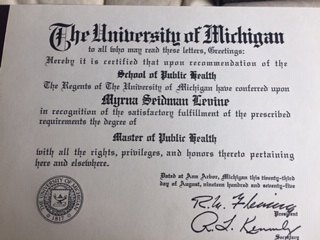
The seed was planted by my colleague Arnold N., on the train ride between Washington, D.C. and Philadelphia. We were on our way to a meeting when he told me about the On-Job/On-Campus (OJOC) Public Health mid-career program at the University of Michigan.
I really wasn’t thinking about going back to school, but Arnold responded to a feeling of professional malaise that I expressed. It was a vague ill-defined feeling, but Arnold, who loved mentoring younger professionals, picked up on it and immediately offered suggestions. Years later, and after my divorce, it occurred to me that the malaise may have been more related to my marriage than work. But at that time, it felt safer to express feeling unfulfilled at work than anything more personal and threatening.
“It is a new program, developed by The Office of Economic Opportunity (OEO) and the University of Michigan School of Public Health. Its purpose is to provide professional education for staff running Community Health Centers, many without formal credentials, but it is also open to other people,” he added.
His enthusiasm was contagious, describing program features that were quite appealing to me.
“Your classmates would be mid-career professionals, like you, working at their jobs while attending classes four days a month, in Ann Arbor. And, you know some of the people in the current class,” reeling off their names.
“Talk to them, get their impressions and give it some thought.”
“I definitely will think about it,” as I pulled out a pad and wrote down the names.
We discussed it some more on the way back from Philadelphia, and by the time I got home, I was excited about the possibility and had decided to pursue it further.
I spoke with the people Arnold suggested, who offered many positive comments, and URC (University Research Corp), where I was working at that time, agreed to give me time off with pay to attend classes. Now I needed to have a serious talk with Julie, my husband. Although I had told him that I was exploring the program, I was casual about it until I checked all the boxes and felt sure that it was a good fit and I wanted to go.
I had anxiety about broaching it with him. Even though I was working 4/5s time, I was carrying the brunt of the household and child care responsibilities, and participating in the program meant he would have to step up for at least four days a month. The children were young, 9 and 7, and although we had full-time household help during the week, he would need to be present in the evenings, Wednesday through Friday, and one weekend a month for two years.
“We need to talk about the Michigan program,” I said. “It looks very promising. I like their approach of combining work and study and it feels like a good fit for me, so I am seriously thinking of submitting an application.”
“What will it involve?” he asked, in a neutral voice, not revealing what he may have been feeling.
“I’ll be in Michigan four days a month, Wednesday through Sunday, while I continue working at URC. I like the idea of studying with mid-career people like me, rather than with kids fresh out of college. If I were to commute to Hopkins for an on-campus program, I’d probably need to cut back on work or stop entirely, so this option of going to school while working is really appealing. Obviously, you’d need to provide coverage for the kids when I am gone.”
“If that’s what you want to do, do it,” he replied, not raising any objections and seemingly supporting my decision. I took it as an endorsement, thinking this was easier than I expected.
His response was muted, and though I couldn’t tell what he really felt, I decided to go with his OK without probing further. Probably he felt he couldn’t say no, but I was troubled by his lack of engagement and perhaps indifference.
The year I completed the program, his probable resentment hit me, though there were some subtle signs before then, like leaving our bed unmade, which he was usually fastidious about. We were in synagogue on a Saturday, and a member was called to the bima to announce his wife’s completion of an MSW program, a mid-career effort for her. His effusive praise highlighted for me Julie’s indifference. My body turned cold, as awareness of the contrasting responses really hit me.
In preparation for the first class session, which began the second week of September 1972, I cooked and froze dinners for the four nights I would be away, marking the contents of each package and the day it was to be eaten, before placing them in the freezer. I was trying to fulfill what I felt was my responsibility, while also making it easy for Julie. One day in class, I shared my monthly preparations with Art, a younger doctor from Buffalo, who was quite astounded. “You really do that, every time?” he said, laughing in surprise. It was clear he had a more egalitarian marriage and would never expect that from his wife. I don’t know that Julie expected this, but my sense of guilt and responsibility led me to do it without questioning my actions.
The first trip to Ann Arbor became the blueprint for all the subsequent trips. I caught a mid-afternoon Wednesday flight from DCA on Northwest Airlines, arrived in Detroit airport around 4 PM, and then took a shuttle to The Campus Inn, our home away from home, where the OJOC students stayed. After checking in, we commandeered tables in the lobby restaurant, ordered drinks, caught up on assignments or personal news, and waited for arriving classmates to join us. By dinnertime most of the tables were filled.
Very quickly, hanging out in the lobby restaurant became the ritual not only for Wednesday nights, but for many of the nights we were there. If conversation or company after class was wanted, we knew where to find it. Ironically, that’s where I drank more liquor than at any other time in my life. It was a drinking crowd, a rather new experience for me, and it was there, while studying for an MPH, that I was introduced to a Black Russian, a mixture of vodka and Kahlua which became my drink of choice then and for years afterwards.
My fellow students, 38 in all, came from the area east of the Mississippi, as there was another program with the University of California for people west of the Mississippi. They ranged in age from 35 to 60 and the class was racially and professionally diverse, including administrators, researchers, doctors, dentists, and nurses, slightly more than half of whom worked in Community Health Centers. We were all mid-career with diverse backgrounds and personal and professional experiences.
Smitty, a native of Detroit, where he still lived, was tall, light skinned and always stylishly dressed; in winter in a light brown long camel-hair coat and in suede and leather jackets when the weather grew warmer. He had a deep and mellifluous voice, with careful and precise diction, but revealed little about himself, except that he successfully combined ownership of a chain of laundromats in inner-city Detroit with administering a Community Health Center. He was proud of his success in business, saying he could never live on just his administrator salary. We were curious about Smitty’s life and background, but that was not something we could ever discuss. He was kind to his fellow classmates, regularly offering rides to the Detroit Metro airport at the end of classes on Sunday. Unfailingly, he brought a pragmatic perspective to class discussions of the challenges of providing health care to inner city populations.
Jeanne K., the wife of a heart surgeon world renowned for developing the intra-aortic balloon pump, had been his lab administrator since their marriage. Petite and in her fifties, she was the mother of three grown children, all doctors, and lived in a beautiful lakeside house in Pontiac, Michigan, about an hour’s commute to Ann Arbor. In addition to being a heart surgeon, her husband piloted his own small plane, and I loved her stories of flying to Chicago for lunch or dinner and then home again, all in one day. Twenty years older than me, we became class buddies and maintained the friendship for many years after graduation.
MaryAnn, a petite dark-skinned woman, and a tough, outspoken Nurse Administrator in Atlanta, Georgia, grew up poor and proud in rural Georgia, working hard to climb the professional ladder. A single mother of one son, she returned to school after her son was born, moved to Atlanta and supported herself through Nursing School. She was gutsy and outspoken, effectively representing to the class the perspectives of the poor black patients she saw in her work.
Antonio, Assistant Director of the Providence, R.I., Community Health Center, about 5’6” in height with light brown skin consistent with his Hispanic background, sat quietly in the back of the class, rarely participating in class discussions and infrequently socializing after class. Mostly keeping to himself, he was thoughtful and knowledgeable, but also perhaps shy and modest. We became buddies during the second year of the program, when we worked together on a class assignment, and then at his urging I visited him in Providence on my way back from a work trip to Boston. I was looking forward to visiting his clinic, but he took the afternoon off to show me the changes in Providence since I attended Brown, about 15 years earlier. I was delighted to see the waterfront walk and other developments in process, but was puzzled about why he chose not to show me where he worked. Although we were friendly, he shared very little about his personal life, and during the class’s last program weekend we were all shocked to realize how little we knew him, or about him.
Classes were held from 9 to 5, Thursday through Saturday, and until 1 PM on Sundays, in a large classroom with two U-shaped rows of tables and chairs and a large rolling blackboard in front. This was our classroom/meeting room where the professors rotated through to deliver their lectures. The OJOC program was conducted as a replica of the on-campus one, and some of us were disappointed that the faculty did not take advantage of our weekend presence to organize cross-disciplinary seminars involving discussions and presentations from several faculty members. Nevertheless, the courses and instruction were first-rate, with highly respected and widely recognized faculty.
Avedis Donabedian, author of a 500-page authoritative textbook on Medical Care Organization and one of the stars of the program, taught a year-long course on approaches to organizing medical care. A thin man in his late 50s, he was quiet, reserved and thoughtful, often pausing to think before answering a question. Although one of the giants in the field, he was modest and unassuming. He welcomed questions, was responsive and respectful of students, and we felt it was a real privilege to study with him. Other classes included Health Education, Health Economics, Biostatistics, and Health Law, which I fell in love with and which made me wonder whether I should have gone to Law School instead of Public Health.
The program was administered by Roy P., hailing from Brooklyn with a New York edge, which unnerved some of the students who took his aggressively gruff manner personally. He had envisioned the program and was instrumental in selling it to OEO, the funder, and to the School, and we interfaced with him around the program’s administrative issues.
We spent the last few months of the program in field teams collecting data and analyzing specific aspects of the outpatient primary health service of Sinai Hospital in Detroit. During the last session of the program, the teams presented their results to hospital officials, discussing our recommendations for addressing problems the teams identified. It was scheduled for Saturday, the last formal session of the class, to be followed by a dinner and celebration of our program completion. Although the team presentations to Sinai Hospital officials and the discussions afterwards went well, representing a fitting culmination of our work, the final weekend was not at all what we expected.
During our team meetings on Thursday, I noticed that Antonio was absent, and as I asked around, I learned that Art, one of our physician classmates who came in with him from the airport the day before, had observed that Tony was not himself and seemed quite depressed. On Thursday, he convinced Tony to go with him to the Student Health Center, where Tony was seen by the staff psychiatrist, who determined that he was not a danger to himself, so he returned to the hotel to rest. He reported feeling better to classmates who stopped by his room that evening, and we felt reassured. Late morning on Friday, however, we learned that Tony had taken his own life in the early hours of the morning; that his wife had been informed, and that the school was handling the necessary arrangements.
We were stunned and a pall came over the class. Although we had an assignment to complete and presentations to make, we had real difficulty putting Tony’s death aside and concentrating on our work. We felt numb and had lots of questions; primary among them was how the health service failed to identify the severity of his depression and hold him for further observation. We were angry. At the same time, we knew that if Tony was determined to end his life, he would know the right answers to give the examining psychiatrist. Our brush with the limitations of health care left a sad taste in all our mouths.
In spite of our sadness, we managed to bottle up our feelings and finish our work, including team presentations to senior officials from Sinai Hospital.
The “celebratory” dinner on Saturday night was anything but a celebration. Rather it became a chance for us to try and piece together what we knew about Tony, try to understand why he took his life, and honor our memories of him. We spoke softly, recalling that the month before he had seemed out of touch, and I remembered him telling me that the Mafia were making trouble for him in Providence. “They are threatening me,” he said. “You know they are big in Providence; they practically own the city.” I didn’t know how to react when he told me; on the one hand it could have been plausible, but on the other, he never believably explained why he was on their list. Some of my classmates recalled similar conversations, expressing regret that they didn’t see it as a symptom of a troubled man.
When the weekend ended, we gave our hugs, said our good-byes, and promised to stay in touch. In the subsequent years, I saw many classmates at the annual meeting of The American Public Health Association and especially in the University of Michigan hospitality suite, which made catching up with faculty and classmates easy. Seeing each other provided sweet memories, made sweeter by learning how well we were doing, personally and professionally. For me, the MPH degree gave me the necessary credential to move into international health when the opportunity presented itself. Though that was not on my agenda when I enrolled, it was a serendipitous opportunity that provided an interesting and satisfying second chapter to my career.