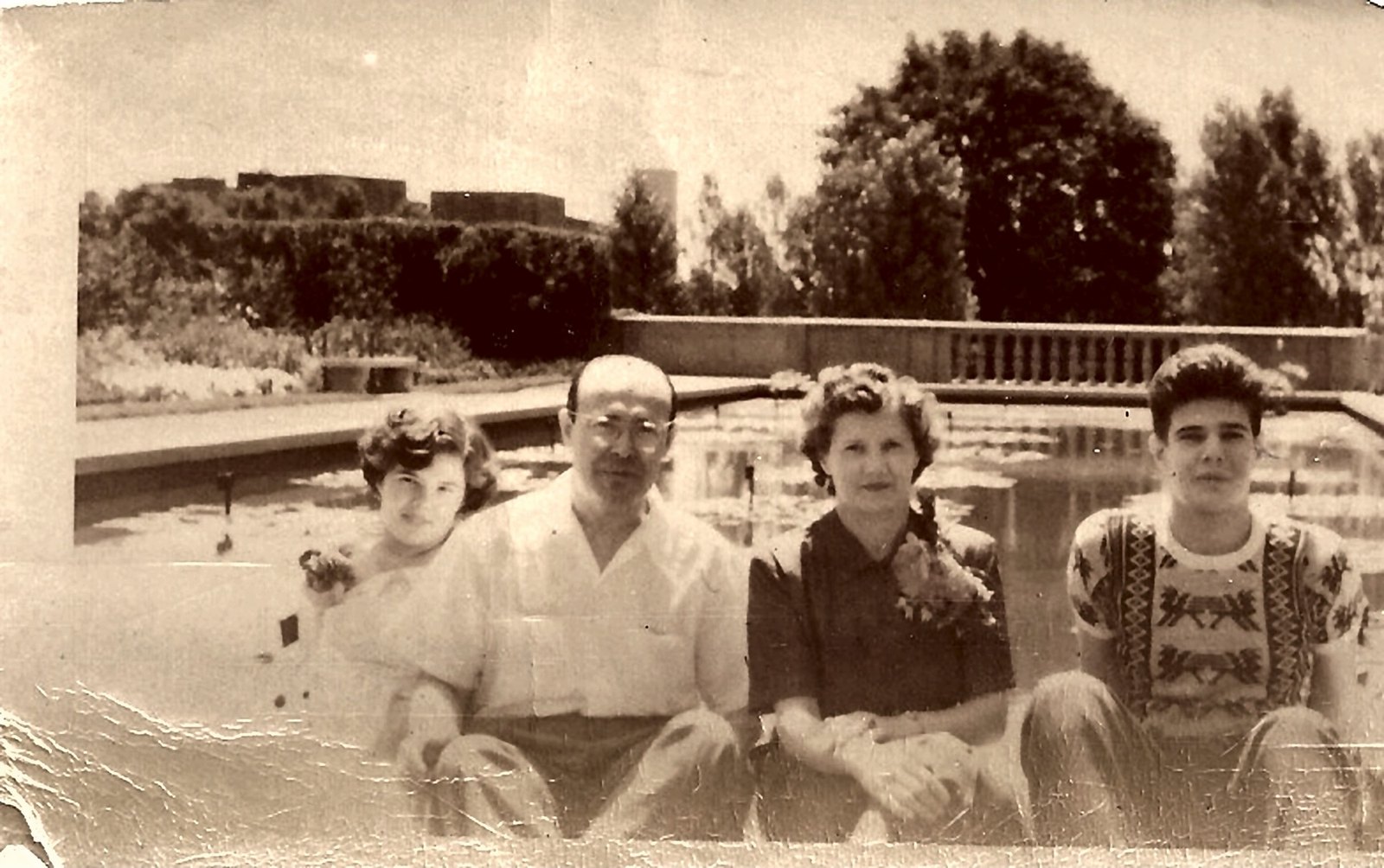
I can hardly believe that I have lived so long, having just turned 85, but when I realize that I remember World War II, it seems quite plausible.
On Monday evening, Dec 8, 1941, my parents, my brother Sam, and I gathered around the Philco floor model radio occupying a central place in the living room, to hear an address from President Roosevelt. We lived on St. Marks Avenue, in an eight-family apartment house just a few blocks from my father’s Hardware store.
Although my mother listened to a small radio in the kitchen, mainly to music and her mid-day soaps, Sam and I preferred the radio in the living room where, sitting on the sofa, we took many flights of adventure. We galloped along with the William Tell Overture introducing The Lone Ranger, shouted knowingly that Tom Mix, was brought to us by Ralston, that only
“The Shadow knows what evil lurks in the hearts of men”, and that Henry Aldrich would always respond, “Coming Mother”, when she called, “Henry, Henry Aldrich”.
That night we all gathered for a message from our president. I was just five years old and I didn’t understand what was happening, but looking at my parents’ faces, it felt serious and important. We sat quietly waiting for the President to begin. Later, Sam explained that “They knew Roosevelt would declare war because of the surprise attack on Pearl Harbor and that was the only thing on their mind all day.” Sam said that our parents were very worried about what it would mean. My father had family in Europe that he was still in touch with.
I didn’t know what war was, what it meant or how it would change our lives. Little by little, however, I began to see the new things we did because we were at war.
The very first sign that things were different was that the clock on the landmark Williamsburg Savings Bank Tower went dark, and we could no longer see it at night. The night felt darker without the clock’s lit up Roman numerals, and I felt sad to look out the kitchen window and see only the darkness of the night. When I was seven, I took dancing lessons at the Felix St. Music School, around the corner from the bank, and I always looked up to see the tower and the clock. Many years later, this building was given landmark status, which meant it could never be torn down. That seemed right to me because not only was it a unique and beautiful building, but it was special to me, because I learned to tell time on that clock.
Then there were the air raid drills at school. The alarm would sound and we clambered under our desks, staying very still until the all-clear siren sounded. Fortunately, I was little so it was easy for me to fit under the desk, but I wondered how it was for the bigger kids.
We also enthusiastically sang war songs; standing straight like soldiers, stamping our feet and singing out, maybe even shouting a little, at the top of our voices. My two favorites were The Caissons Go Rolling Along, and the White Cliffs of Dover. Even to this day, the words of these songs periodically pop into my head. I was an adult, perhaps in my forties when I saw that the cliffs of Dover were really white, just as the song said. I also learned that the Caissons were used primarily in World War I, and that song was from the first war.
In first grade, when we began to learn our letters, we made the V for Victory sign, holding up the two fingers in our right hand to form the V to help Vernon V., a class mate, remember what it looked like. Holding our fingers in the air, we would shout out, “V for Victory, Vernon V..” I didn’t know then that Prime Minister Churchill made the V sign to give his people courage during the terrible days of the London bombing and the war. I thought Miss M. made it up to help Vernon.
The front room windows that overlooked St. Marks Ave, only had wooden blinds so my mother had to buy and hang black shades so the light would not show through. When the air raid sirens went off, we pulled down the shades, shut off the lights and sat in the dark. We could hear the air raid wardens patrolling the streets, flashing their lights and yelling at windows that were not completely dark. Some of the wardens were our neighbors, but with their helmets, whistles and large flashlights, they became important officials protecting us. Lucky for us, we only had drills unlike the people in London whose houses were destroyed in bombings. I saw pictures in the newspaper and I worried every time the sirens went off, in case it was real. Sam would reassure me, saying, “we are too far for the Germans to bomb us”
The government promoted recycling of metal, tin, paper and fats, and I still remember the acrid smell of cans we washed, crushed, tied with string and brought to the butcher shop across Fifth Avenue, near St Marks Ave. for recycling. Our family didn’t eat a lot of canned foods, so it took us awhile to accumulate enough to make a respectable bundle. Sometimes, we would offer to take our neighbors cans, so we could add to the ones we had and make the bundle larger, more quickly. Sam and I disagreed about removing the labels, before we stomped on them to make them flat. “It’s unnecessary,” he said, “But I like to do it, it seems neater” I replied. We also saved and recycled our newspapers and brought them, along with the crushed cans, and jars of fat my mother had accumulated to the butcher shop. Its floor was covered with sawdust, and I liked smushing it with my feet as we waited to turn in our haul. If the wait was long, I would write letters in the sawdust with my feet. When the war ended, we stopped recycling for more than 40 years.
Then there were the ration books issued by the OPA (Office of Price Administration). First, they rationed sugar, then meat, butter and cheese, and pretty soon almost everything we wanted was rationed. My mother had different books in different colors for specific items, and she brought them with her when she went grocery shopping. The storekeeper was supposed to detach them, but they weren’t too strict about that, because my mother often gave her unused sugar rations to Mrs. J., the mother of my friend, Joyce, who lived downstairs. She put the loose stamps in her ration book, so it looked like they were hers. “Why does Mrs. J. need our stamps,” I once asked my mother. “She has a large family and they use a lot more sugar than we do,” my mother explained. Only later did I realize that wasn’t a good answer, because ration books were allotted according to the number of people in the family. I guess they used more sugar than we did.
The one thing I noticed that was hard to get was Double Bubble chewing gum, which was my favorite; it was tastier, lasted longer, included a comic strip and definitely made better bubbles. For a while during the war, I couldn’t buy it at all. Then one day, Sam told me the candy store around the corner from school was selling them. I raided my piggy bank and bought about 10 pieces, hiding them at home and rationing them carefully so they would last a long time, as who knew when you could get them again. I never told Sam how many I bought, as I was sure he would disapprove and call me a “spendthrift.” The gum was two for a nickel.
Joyce J., my friend, who lived downstairs from me, was the youngest of five children in her family and her oldest brother Frank enlisted in the war soon after Pearl Harbor. I didn’t know him and Joyce rarely talked about him, except to tell me when her mother received a letter from him, which was not very often.
Joyce’s father was a garbage man who worked for the New York City Sanitation Department, and a Republican. That didn’t make sense to me, as my parents always said, “the Democrats are for the working people”. I didn’t understand why he would be a Republican because I saw how hard garbage collectors worked, emptying the heavy garbage cans into the garbage trucks. Mr. G., who lived on the fourth floor, delivered coal, which was also hard work, but I don’t know whether he was a Republican. They were Irish, so maybe he was a Democrat. Joyce’s family were Protestants.
On the day President Roosevelt died, I went down to see Joyce after listening to the news on the radio with my mother. I was sad and shared my mother’s worries about the war and the country, and wanted to talk to Joyce about it. At that moment I had not thought about Democrat or Republican, just that our much loved president had died. Joyce opened the door as soon as I knocked, and gleefully shouted, “Roosevelt is dead, Roosevelt is dead.” I was so angry that she was taunting me that I turned on my heels and replied, “I am not playing with you today, you are mean,” and went home. I couldn’t imagine anyone being happy about Roosevelt’s death.
The next day at school, my teacher tried to reassure me. “President Lincoln was shot and died just before the end of the Civil War, so maybe Roosevelt’s death is a sign that the war will end soon.” I felt somewhat better, but couldn’t imagine the country with someone else as president. He had been the only President I had ever known, and my parents thought he was a great president. I did too for a long time, until I learned when I was in college, about the actions he failed to take to protect the Jews in Europe. A few years after he died, the government issued Roosevelt dimes, and my grandfather had them made into a bracelet for me.
I was reminded of Roosevelt’s reticence toward saving the Jews when recently I saw a one-man play called Jan Karski, performed by David Strathairn at The Studio Theatre. Having escaped from a concentration camp, Karski was asked by the Polish government in exile, to share the horrors he had seen with the world leaders of the allied nations. He met with President Roosevelt, and as he enacted it on the stage, Roosevelt kept changing the subject every time Karski tried to describe what was happening in the camps.
One day, in the middle of the war, I opened the mailbox and saw a letter from the Selective Service Board, addressed to my father. By the time I climbed the stairs to the apartment, clutching the letter tightly, I was convinced that my father was being drafted. I gave my mother all the mail except that one. After she glanced at the envelopes I gave her, I added the one that was so scary to me. “Is dad being drafted,” I asked, as I handed it to her, while trying to control the lump in my throat, so I wouldn’t cry. “No, no,” she replied reassuringly, “He’s too old and he has a family. They prefer younger men.” She opened the envelope and showed me that he was being asked to update his registration. I exhaled a sigh of relief.
On my street, a pennant with a gold star hung in the window of a house a few doors from my house. The simple pennant occupied most of the window where it hung prominently. When I asked why, my mother explained, “That’s a gold star mother, because she lost a son in the war.” I looked at the star every time I passed the house, and felt really sad for the family. There were at least two more gold star mothers on my block. Although I had a few older cousins in the war, fortunately they all came home safely. However, when I met my husband, I learned about Lester, his cousin of 19, who died on the beaches of Normandy.
I couldn’t escape thinking about the war, even when I went to the Saturday matinee movies with Sam. The Atlantic, our neighborhood movie house on Third Avenue and Pacific Street, showed double features along with Newsreels which included scenes of the latest battles, the heroism of our soldiers, and news from the home front, along with appeals to buy War Bonds. My mother took me to see Mrs. Miniver, an award-winning British war film starring Greer Garson and Walter Pidgeon. It was about a British family trying to survive the bombing raids. I was about 8 or 9 and found the movie frightening and missed half of it by shutting my eyes or hiding my face in my mother’s coat. I recently looked the movie up on the web, and since it is streaming on YouTube, I plan to watch it again, hopefully, without averting my eyes in fear.
Appeals to buy war bonds were also made on the radio, posters were hung around town showing slightly wounded soldiers, and there were big rallies led by famous movie stars like Hedy Lamarr, or radio personalities like Kate Smith, who my mother listened to regularly. It was patriotic to buy war bonds to help the war effort, and Sam and I got them as presents for birthdays and holidays. I felt that I was helping to win the war and it was a good deal because when you redeemed them, you got more money back than you paid for them.
In July, 1945, shortly before the war ended, the New York newspaper deliverymen went on strike. “So the children wouldn’t miss the comics,” the mayor of New York City, Fiorello La Guardia read them each Sunday morning on the radio. That was an event that was talked about and remembered long after the end of the strike.
As my teacher predicted the war ended a few months after President Roosevelt died, first in Europe with the Nazis, on May 8, and then several months later with Japan. On VE day, people hung their American flags out their windows and celebrated by banging pots, parading on the street waving flags and blowing horns and whistles. During the war, my father installed a bracket outside our front window, so we could hang a flag like everyone else did on national holidays and in celebration of the end of the war with Germany.
I was in Camp Wel-Met in the Catskills on August 15, when the war with Japan ended. After the news was announced on the camp’s loud speaker, we were called to the flagpole to raise the flag, sing the National Anthem and the patriotic songs we had learned during the war. The entire camp of over a hundred children was there, celebrating, stomping our feet, clapping our hands and whooping it up. By the time I returned home from camp, the lights on the Williamsburg Savings Bank clock had been turned on, proving that the war was over, and enabling me to tell time at night.
About a year after the war ended, my father received a letter from his youngest brother, Isaac. All during the war there was no word from my father’s parents and four siblings in Romania, and my parents feared the worst, with good reason. Isaac was the sole survivor having fought with the Russians during the war, thus escaping the labor camps, disease and starvation experienced by his family along with the local Romanian population. My parents sent Isaac regular Care packages for several years, to help him get back on his feet.
We also got our first telephone around the same time. It was a big black heavy thing with a separate receiver, and a rotary dial with 10 finger holes for dialing the digits 1-9, plus zero. It sat in a prominent place in the living room and we had a Dewey exchange and a party line.
Three years after the war ended, my parents bought a new two-family house in Flatbush, a quiet, safe residential area. The house had a yard with a forsythia bush with bright yellow blooms which announced the arrival of Spring. The house also came with a garage, which we used for extra storage because our family never owned a car.
The post-war period was a good time. Conditions continued to improve for people, there were more things to buy and a sense of peace, prosperity and tranquility enveloped the country…. until the Korean war broke out in 1950.