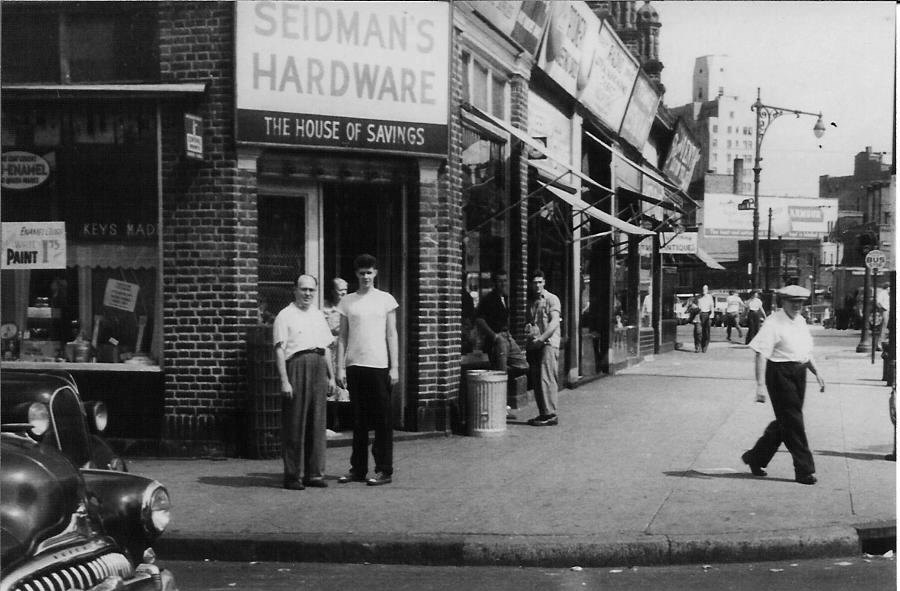
My father’s hardware store was more than a source of income for the family; it was a family enterprise, much like a family farm. We lived just four short blocks from the store; we were frequently there, and we each had roles to play.
My father learned the hardware business serendipitously. He had no trade or special skills when he arrived in this country, at the age of 16. The only work he had ever had was as a horse trader. That was short lived and he didn’t earn any money from it. As he explained, “I was to bring customers to a man who traded horses. If the customer bought or traded, I would get a share of the sale”. But there was no business and he never made any money. He told that story to explain what impelled him to emigrate.
When he first arrived, he lived with Ida, his eldest sister, who had emigrated several years earlier. Morris, her husband worked in the wholesale hardware business on the lower East Side of New York City. It was a large establishment primarily supplying jobbers (middle men), who sold to the retail trade. Within a few days of arriving, my father started work as a stock clerk, and little by little he learned the business.
He worked six days a week, 10 hours a day, and extra hours on Sunday, to compensate for leaving earlier twice a week to attend night school. The desire to work for himself grew; but when and how were the gnawing questions.
He wanted to marry my mother, but he felt he needed more financial stability and he asked her to wait until then. Striking out on his own seemed like the only answer; but it was the depression and the risk of failure was great.
Then he heard that a man who used to work with him wanted to sell his hardware store. It was located on Flatbush Avenue, not far from his ultimate location on 5th Avenue near Flatbush Avenue. The terms were good; Morris helped him with the financing, and after a small down payment he could pay the balance from monthly proceeds.
He was now 24, had worked in the wholesale business for 7 years and was ready for his own store. He was still single, but he told his customers he was married because he felt they would take him more seriously.
But it was also the middle of the depression and covering his costs was a continuous struggle. When Prohibition ended in 1933, and liquor became legal, the owners of the store where he was located improved the property and raised the rent. They hoped to open a saloon and raising the rent was a way to force my father out.
So Morris joined the business and they moved the store to Coney Island, which didn’t turn out well, as they had competition close-by that served the local trade. They hired a salesman to make calls and hopefully generate business, and although he made a number of calls each day, it did not result in new customers. He quit after 2-3 weeks. Then Morris took on the sales job, but within a short time it became clear that it was not a suitable role for him. My father said, “He was uncultured and didn’t know how to talk to people properly”. Morris must have felt inadequate too.
One day when my father closed the store to go to the bank, taking a shortcut through a neighborhood park, he found Morris dozing on a bench. That confirmed my father’s suspicions about Morris, and his feeling that their partnership would not work.
Many years later he explained “ The partnership was built on mutual desire. We both wanted to go out on our own and working together seemed like a way to make this dream possible. It also seemed like a good idea for after all we were family. But Morris was not a hard worker, while I had a family to support.”
He hung in awhile longer because he didn’t want his sister to suffer. Nevertheless, when the split occurred, his sister blamed him and their relationship was strained for a long time. My father didn’t talk much about the details or how difficult it must have been; but his sister Ida never forgave him.
They were on the verge of bankruptcy when they split up. My father consulted a lawyer who told him not to pay his bills, and instead pay the creditors the portion of the debt he could afford. My father was appalled with the advice. He felt his “good name” was the most important thing he had. By paying a little each month, he ultimately paid off his debts. The landlord helped by allowing him to pay the rent on a weekly basis for his remaining months in the Coney Island store.
Morris kept the store in Coney Island, and my father moved to 144 Flatbush Avenue, close to the Long Island Railroad station, a few blocks from his earlier location. Within a year, he learned of the availability of a corner store on 5th Avenue and Dean, which offered better visibility, space and location, and he moved there. That was his fourth location in about 8 years, but he remained there for close to 40 years, until he retired from the business. Within a year, the family moved to 11 St Marks Ave, four blocks from the store, considerably reducing his daily commute. That was important because he kept the store open 12 hours a day, from 8 to 8, six days a week.
The store had windows on both Dean Street and Fifth Ave, but the interior was small and cramped, and merchandise occupied every possible inch of space. A counter containing bins for different sized nails stood at the back of the store, facing customers as they entered. Nails were sold by weight, and each bin contained a different size and type of nail. As a child, I enjoyed running my hand through the bins, feeling the cold, hard texture of the nails, and going from bin to bin to feel the different widths and lengths. Many years later when my father visited me in Washington, I took him to Hechinger’s Hardware store. He couldn’t believe his eyes at the size of the store and variety of merchandise it sold, but he was most shocked that nails were sold in small packages at “outrageous prices.” Unfailingly, he would tell me how much nails cost in his store.
A brass intricately decorated NCR cash register (that today would sell as an antique for between $600 to a thousand dollars) sat on the back counter along with a roller of brown paper for wrapping purchases. On occasion I was allowed to make change for a customer, usually a regular who was willing to indulge “Hymie’s daughter”. Making change was hard work. The keys were spaced far apart, at least for a small hand, and they required pressure to push. Then when the cash draw opened, I needed to rely on my arithmetic skills to know how much change to give. But to be sure, I always checked with my father. My father also made keys at this back counter. I liked watching him move the machine to cut the key in exactly the right place, matching the original. When I have keys made today I can’t help noting that the key-making process is automatic, hardly requiring the careful attention my father gave to the task. The prices too have increased, geometrically.
Both sides of the store had shelves from the floor to the ceiling for storing paints, brushes, tools and related supplies. A wooden ladder on rollers provided access to higher shelved items. I wasn’t allowed to climb the ladder, but I often sat on one of its lower rungs turning it into a private bench. A counter ran down the middle of the store providing additional storage and display for saws, hammers, drills and tools. The more expensive items were kept locked in a glass cabinet above this counter.
Fifth Avenue was a street of small stores. A stationery store, a front for illegal horse- betting, carried out in the renovated store cellar and thus not visible to the casual customer, stood next to my father’s store. The betting-parlor would turn out to be important in the life of my father’s store. The block also housed a radio repair shop, a small restaurant, a luggage store and an ice – cream parlor on the corner. Greek owned, Cardessi’s, was our favorite store, and their ice cream cones the best.
Across the street on a triangular block, was Triangle Sporting Goods, one of the largest and most successful stores in the neighborhood. My mother bought all our camp supplies there, and the owners were the most generous contributors to my annual Sunday School solicitation for planting trees in Israel.
Though he had moved to a better location, my father still had difficulty making a living. He said, “When I sold merchandise and got my costs covered, I was happy because I needed the money to circulate and also something to live on. Everything was cheap and my profits were pennies. A pound of nails sold for 5 cents and plaster for 2 cents. I bought it by the barrel and sold it loose to make a very small profit. I would get as dirty as a pig,” he recalled
My father struggled financially during the depression, but with the outbreak of WWII, things began to improve financially. He received permits from the government to acquire and sell merchandise that was hard to get. He sold to groups that had been approved by the government, like the Brooklyn Navy Yard and Ft Greene Market. They became accounts that continued until he retired.
In addition to his walk-in and regular customers, there was a group of men who hung out at the store: characters out of Damon Runyon’s Guys and Dolls - working-class, intermittently employed womanizers, who regularly played the horses at the “stationery store” next door. The core group included current and former Navy Yard workers; Frank, an electrician, Daley a skilled carpenter, Ernie, a handyman, and Charley, a semi-skilled worker. They had a symbiotic relationship with my father,
though they were as different from him as night and day. He was a family man, with a wife and three children; he worked hard to support them and lived a traditional family-oriented life. None of them had children and none were married, though they often talked about their women, sometimes more than one at a time.
They could be seen, usually beginning in the late afternoon and extending into the evening, sitting either singly or as a group in front of the store’s radiator, towards the back of the store. Often their conversation was about horses, who were the best ones and whom should they bet on. They studied the racing sheets and had voluble and often argumentative discussions about which horses they should bet on for the next day’s race. Hearing all the chatter about the racing genealogy of the various possibilities, my father once offered his opinion. “ I think you can’t go wrong with that one; after all his mother was a horse, his father was a horse, so he is likely to be a good horse.” I think his ironic humor may have been lost on his companions.
Their presence was encouraged, probably even welcomed by my father. They provided company, especially in the evening hours when business was slow, and the risks of being alone in the store were greater. I know my mother was glad they were there, sometimes sending extra portions of food or snacks to be shared with them. It was a mutually beneficial relationship.
They had a friendly and convenient place to wile away the hours; my father had company and an extra degree of safety. Sometimes they ran errands or stayed in the store while my father took a quick trip to the bank. With my father’s help, they picked up small jobs, and sometimes when the store was busy they waited on customers. Occasionally my father extended small loans to tide them over to their next paycheck.
Over the years, the relationships extended from the store to the home and family. Frank helped me learn to ride a bicycle tightly holding on to the seat as I maneuvered to find just the right balance. Daley, a Scotch-Irish amateur photographer, took family pictures on at least two occasions; initially in the home when I was about 5 years old and many years later, color prints at the Brooklyn Botanical Garden. My father felt Daley was the most refined of the men and felt a special kinship towards him.
Ernie, a Swedish immigrant, drove a car, which we didn’t have, and occasionally did errands for the family. One day, after helping the family out, my mother asked him to stay for lunch. He was a small, bald, rather rotund man, and very talkative. That day he wore brown pants, a yellow plaid shirt and suspenders; his clothes appeared more coordinated than usual. He held his brown plaid workers cap on his lap during lunch; probably the only time I saw him bald and bare-headed. At one point during lunch he said he wanted to tell a “yoke”. My brother and I looked down at our plates, avoiding each other’s eyes and trying hard to stifle our giggles. I don’t remember whether we were completely successful, but for years thereafter, we would say to each other, “ I have a yoke to tell you,” and break up into laughter even before we told it.
One Sunday, Ernie took the family out to Long Island, so my father could look at a piece of land to purchase. I don’t know whether it was in partnership with Ernie, or a resolution of a debt, but my father did make a purchase. “Long Island will some day be developed and then the land might be valuable,” he said. The first part of the prediction came true: Long Island did get developed, but the land never became valuable, though he might have made a small profit when he finally sold the property years later.
Although my father’s store did not specifically cater to the “walk-in” trade of neighborhood housewives, the Christmas season was different. Under my mother’s urging he made an effort to decorate the windows, giving them a seasonal look with lights, tinsel, and decorative paper. She also urged him to showcase consumer items like toasters and irons, which he carried year-round but didn’t promote. For the season he also stocked tree lights and decorations, which attracted people shopping for trees, sold by an independent vendor, on his long Dean Street sidewalk. I don’t know the arrangement between my father and the tree seller, but his presence drew customers to the store for the trimmings they needed for the trees they had just purchased. That was the one time in the year when Dean Street had a festive feeling, along with a wonderful aroma of pine.
We lived just four blocks from the store, and it loomed large in our lives. We were there regularly on Saturdays, its busiest day, when my mother helped out, and later my brothers. During the week, we frequently brought my father a hot lunch, when we returned to school at the end of our lunch-break. Since we had an hour for lunch we could manage the four-block detour. And my mother stressed “this saved her a trip and provided my father, who worked hard, with a warm meal.” Sometimes I could linger for a few minutes, and if he wasn’t busy, I saw him look in the brown bag, and take out its contents with interest and pleasure. That made my detour to school worthwhile.
Sam, my older brother, started working in the store on Saturdays when he was in his teens. He waited on customers, made deliveries, ran errands, and helped to keep the clutter down and the store clean. He also waited on customers, but because most of the merchandise was unmarked, he often had to ask my father the price. He also helped carry heavy items, like garbage cans, bags of sand and cement up from the cellar where they were stored. When Dan my younger brother came of age, he too helped out in the store. Dan became sufficiently conversant with the business that he was able to run it for a week after my father had a hernia operation and then for two weeks when my father and mother took a trip to visit his brother in Romania.
My main contribution occurred monthly, when I prepared the bills for his credit customers. My father maintained a large ledger that sat on the middle aisle counter in the store. It was a big book, measuring perhaps 15 x 20, with three blank bills per page, each about 4x5. My father’s name and store address were engraved on each bill, which had two carbon copies, one that the customer signed and was his receipt and one that remained in the book. My father kept the original copy and it was sent monthly with a statement that I prepared summarizing the monthly expenditures. Unpaid balances were also reflected on the statement, but only a few customers had balances, even though my father did not charge interest.
Early each month my father gave me a stack of bills he had removed from the ledger. They were organized by date of purchase, so my first task was to group them by customer. I used my parents’ double-bed for that task, spreading out the bills so the names could clearly be seen. Then they were collated by customer’s name and the month’s purchases summarized by date and amount, and a balance added, if there was one. Envelopes were addressed and soon the monthly statements were in the mail. This task required one day’s work, which I usually completed on the first Sunday of the month. Over time, I got to know the names of his regulars, and watched their purchases wax and wane. A few of their names, like Ft Green Market, Pinchik Paints and Brooklyn Navy Yard, have stayed with me, so many years later.
In 1948 we moved from St Marks Avenue to a two family house in Flatbush. It was now a 30- minute bus ride to the store, making drop-in visits and on-going familial connections to the store and its clientele, difficult. The family was also moving on. I was entering high school, and my mother was engaged with friends and activities in her new neighborhood. My father had more regular help, and closed the store two hours earlier, making his work- day shorter, and avoiding the riskier evening hours. Only my brothers worked there regularly until they started college.
My father retired in the late 70s, just as the neighborhood began its decline into a drug infested high crime area. Twenty years later, when people discovered the beautiful brownstones that lined the streets, its accessibility to the city, and closeness to Prospect Park, my old neighborhood changed again, and became part of Chi Chi Park Slope. The building that housed my father’s store went from a Bodega, after my father left, to an insurance office to a high-class optical shop just one block from the newly built Barclay Center. And 5th Avenue became a destination for innovative cuisine, wine and cheese shops, classy restaurants and clothing boutiques. As my mother would say, “ You just have to live long enough. Then you can see it all”.